Tuesday, August 07, 2007

Vehicular Obsession

Why are people so interested in vehicles? All around the world, as soon as they have enough money for food, what do people want more than anything? A bicycle, scooter, car, or truck. When they finally have plenty of money, what do they want next? A bigger car, another car, an SUV, and a trailer. If someone is lucky enough to have rivers of cash or credit, what do they buy? A sailboat, snowmobile, jet ski, and a Harley. We want a huge RV with bicycles tied to the back, a boat on the roof, and a tow car behind. We would buy jet planes and helicopters if we could. What is the meaning of this human vehicular obsession?

Vehicles are often the tools of production. You can’t get your vegetables to market without a cart. Likewise, you might need a car to get to work. Okay fine. But that cannot be the whole story. You definitely do not need a kayak and a Hummer for anything. A Corolla will get you to
work.
People will buy vehicles even when they don’t need them, can’t afford them, can’t maintain them, and have nowhere to store them. But even if you are swimming in money, why would you spend it on vehicles? How fast do you expect to go on the freeway at 5pm? When I see the sailboats and fishing boats struggling to avoid hitting each other in the bay, I wonder, “Where is the fun in that?”

Why not buy books or music? You can never have too much of those. If money is overflowing your bank account, why not create a scholarship fund, or support health care for people who would really, really be grateful? There are a hundred things to do with money more useful than buying another vehicle.

There must be a deep psychological reason for vehicular obsession because it makes no rational sense. I think it involves subconscious fantasies of omnipotence, omnipresence, and to a lesser extent, omniscience, for the imaginatively challenged.

If you have an attractive, powerful car, then you are attractive and powerful. If the car is expensive, then you must be rich. If it is shiny, you must have good taste. The vehicle defines a new bodily self better than your run-down, flabby body. Actually, even if your body is in great shape, and you look good, and you are rich, you still can’t go from 0 to 60 in five seconds, can you? So you still need a better physical “shell” to fulfill your fantasy life.
Inside the vehicle we put aside our mortal embodiment and become re-embodied as an anonymous homunculus in a steel and glass superbody. The homunculus issues performance commands, enjoys the scenery whipping by, and imagines the awed respect of onlookers (as if anybody really cared how you spend your paycheck).

Other vehicles are seen as people. The person who “cut you off” in traffic is just the red coupe, because you have no idea who is actually in the car. It doesn’t matter. The behavior of the car is the behavior of its driver, just as your car represents your own superpowered body.

Notice that nobody fantasizes about owning a metro bus or an Amtrak train. We’re not interested in possessing public transportation, only personal vehicles. It’s not actually the vehicle we want, no matter how big it is. What we want is a fantasy superbody that can do amazing things.

It is a childish fantasy, like kids who want to be Spiderman, Batman, or Wonder Woman. They can’t think beyond behaving physically in the physical world. Rarely do you hear a child of ten say they would like to become a concert cellist, biologist or novelist. They simply don’t know the range of possibilities that life offers, so all they can think of is running, flying and punching bad guys. Their world view is restricted to the physical.

Vehicular obsessives are that way too. I submit it would be a rare concert cellist, biologist or novelist who drives a Ferrari or owns a sailboat. Why? Because those people have learned to enjoy a life that extends far beyond the physical body.

On the other hand, adults who glorify the physical body and who lack awareness of the depth and extent of intellectual, social, and aesthetic life, would be more likely to suffer vehicular obsession. That crowd would include body builders, dancers, athletes, and people whose mental life is centered around physicality. It would include television and movie actors, models and public figures because they trade in their physical image. The physical is all for them. It would not include radio personalities because only their voice matters so they don’t need a superbody.

If you won the lottery big time, what would you buy? Vehicles?

Friday, July 06, 2007

Science and Islam

I ran across an interesting book by Turkish-educated physicist Taner Edis: An Illusion Of Harmony: Science And Religion In Islam. Prometheus Books, 2007. It is well-reviewed on Amazon.com.

The book asks why Islam has contributed nothing to modern science. The answer is simple, frightening, and perplexing. Muslim society is centered on literal interpretation of the Koran, and when scientific findings contradict scripture, science is rejected.

Unlike western societies, Muslim cultures did not experience a historical period like our Enlightenment, from about 1500 to 1650 and continuing to the present. Cultural attitudes about knowledge and truth changed radically in the west during that time. Instead of relying on the king, the church, and the ancients to define truth, the idea emerged that anyone could find out about the world by observing carefully and thinking critically.

The transformation from authoritarianism to empiricism did not always go smoothly, as when Galileo was imprisoned for insisting that his telescopic observations proved that the Earth was not the center of the universe. But over time, educated people in western cultures came to accept that empirical observation made by any suitably trained person produces truth about the natural world, regardless of pronouncements from crown or cross. That is the definition of modernism and of the modern mind.

None of that happened in Muslim history, for reasons that are not clear to me. Consequently, in today’s Muslim culture, religious authority still defines truth and there is no tradition of science. Engineering is well-advanced, according to Edis, but the mentality for questioning, experimentation, skepticism and reliance on empirical observation required for basic research is lacking. Islamic scholars try to reconcile scientific findings and principles with a literal interpretation of the infallible Koran, much as Christian fundamentalists do with the infallible Bible, and failing to find success in that effort, they turn to crackpot pseudoscience that is more compatible.

While western society was changing during the Enlightenment, Islamic cultures remained dominated by orthodox religious scholars who did not encourage “attention to knowledge that did not have any explicit religious purpose,” according to Edis. If one’s world view is totally defined by what’s in the Koran, then of course science would be a waste of time. But how could anyone live like that? What about natural curiosity?

It seems perfectly obvious to me that given the right population density, health and nutrition, with plenty of commerce to facilitate the exchange of ideas, the modern mind, and with it the scientific world view, would automatically flourish. People are naturally curious, they want to understand the natural world, and given the opportunity to explore, they would. But what is obvious to me is obviously wrong, since it did not happen that way in Islamic societies.

It’s a frightening contrast because it reminds me how totally alienated the two world views are from each other. We are never, ever going to resolve our differences in discussion over coffee! The historical differences have produced mind-sets that are too different to support much discussion.

But why can’t fundamentalists let it be? Why do they have to blow things up? If they prefer to live in a premodern state, why not do so quietly? What is the source of the animosity between us?

There are historical animosities, like the Crusades and the taking of Muslim lands by Israel. But there have been similar animosities in western cultures, including two recent world wars, but we worked it out. There is something else going on in the tension between western and Islamic cultures.

The obvious answer is that we want their oil, and they want our respect. Could it be as simple as that? I don’t think so. Such a simple trade could easily be worked out if that’s all there were to it.

Instead, I think each side wants the other to conform to its self. We want them to be secular democracies like us, with liberal, tolerant values and a modern, scientific outlook, like ours. But they want us to be fervent, unquestioning, literal believers of every word of the Koran, like them. Each side wants to recreate the other in its own image and is not content to let the other be different.

Why this mutually exclusive absolutism? Because each side believes its view of humanity, God, life and world is absolutely correct and that the other side’s is absolutely wrong. These unyielding positions are not just prideful postures. Their assumptions are so deeply ingrained into the fabric of each culture that it is not mentally possible to question one’s own position without a great deal of education and reflection.

We are modernists, products of the western Enlightenment and it is not actually possible for most of us to get free of that and think in premodern terms. It’s not a question of listening more carefully to the other side; we just can’t comprehend their assumptions about the world. Why not?

This is a perplexing mystery.

Monday, June 11, 2007

Who’s the Peacock Now?

Last weekend I had to go to a “gala” charity event. I hate those things, with their ironically named silent auction, with the countdown of time remaining to bid blasted over a loudspeaker to penetrate the din of banal conversation blanketed by a layer of canned music from a half century ago (Ray Charles, Nat King Cole, and even the comeback Tony Bennett, not the Tony Bennett of the 40’s and 50’s who could actually sing). Last year we got a live string quartet. They must be cutting costs. And the speeches, good lord, the unending self-congratulatory speeches! But attending is the socially responsible thing to do, so I hold my nose, watch the clock, and make nice.

(Notice in the picture that my lovely wife is not displaying a peacock fan.)

Anyway, a woman with breath of crab cakes shouted an interesting offhand comment into my face. “It’s amazing what the women wear to these things,” she said, “compared to what men wear.” I looked around and she was right. Women had all manner of fantastic getups, in drapes of shiny fabrics, gauze, or lace; dripping sequins, jewels, and shiny pins; wearing upright collars, enormous floppy collars, no collars; cut-away fronts, backs and sides (not all on the same woman). There was every imaginable color including some you couldn't name. Men, on the other hand, were uniformly in dark blue suits or black tuxedoes. The daring ones allowed themselves a colorful print on the bow tie.

In the animal kingdom, the male is the brightly colored one. That spectacular peacock tail has very high evolutionary cost, since it serves no purpose, save one: to attract females, in the hope of scoring fertilization of some eggs. The eggs are the high value resource that males must compete for.

But in the human world (of charity events anyway), eggs mean nothing. The women give the showy display instead, apparently competing for men. Why? Presumably for the opportunity to score (or retain) wealth and security. The evolutionary script has flipped. How did this happen?

Tuesday, June 05, 2007

Why There Are No Aliens

People are fascinated with the idea that there are aliens out there; intelligent beings like us, or maybe not like us. This theme has been a staple of television and movies for decades, and is an obsession of UFO buffs. Scientists started the SETI project (Search for Extraterrestrial Intelligence) in the hope of making contact with aliens. But there are no aliens.

How can I be so sure? With tens of billions of galaxies each containing hundreds of billions of stars, many of them like ours, statistics alone would argue for the nonzero probability of life elsewhere in the universe.

Ah, but I do not argue against the probability of extraterrestrial life. It would not surprise me too much if bacteria were found in some moist spot on Mars.

What’s impossible are intelligent aliens; beings that have thoughts, and technologies like radio and space travel and who could communicate with us. Why is that impossible? Because it is oxymoronic. It’s like trying to conceptualize a square circle or a flying pig. You can do it vaguely, in abstractions, as long as you don’t think it through too clearly. But if you give the idea a moment of serious thought, it becomes obvious that it is so muddled, we don’t know what we are talking about.

“Alien” means not like me; foreign in nature; from some other context. Yet we always assume our own context. That’s why E.T. (from the famous movie) looks so remarkably humanoid: one head, frontal eyes, mouth for speaking and eating (language too of course), two arms, two legs, one torso, ten fingers, bipedal locomotion, breathes air, functions in 1g of gravity, and on and on. Sure, he has some special powers and some special needs, but don’t we all. The differences are minor. How alien is E.T.? Not very. He is us.

The old TV show, Star Trek, had some imaginative aliens. My favorite was the Hortas. They were a silicon-based life form (as opposed to our carbon –based) and they looked approximately like a two-foot long gray egg with a fringe around the edge. The fringe presumably was for locomotion, as the Horta were ground dwellers. They looked like big rocks, but they were intelligent, as Spock proved by making a Vulcan mind link with one of them. That was a good representation of an alien that tried to cut through anthropocentric imagery. Nevertheless, the Horta still had thoughts and concerns very much human. It was concerned with territory, safety, family, nutrition and longevity. It didn’t look like us, but it was us.

Another good fictional alien was the race of Krell, the mysterious, extinct beings in the movie, Forbidden Planet, who left behind a gigantic underground computing complex. But surprise, they were not extinct as thought, and when they manifest, they appeared as wavering ghostly shapes of light, a sort of body. It turned out that the Krell were actually projections of the unconscious mind of man, the opposite of alien; extreme intimates of humanity. But their initial representation without a substantial body was innovative.

But why would a real alien have a psychology anything like ours? Would an alien distinguish subjectivity from objectivity, as we do? There’s no reason to think so. Would aliens think of the world as separate from themselves? Could they distinguish themselves as individuals in a group, or not? Maybe they would be absolute individuals. Is intelligence necessarily social? Would alien minds undergo years of socialization as ours do? Would they necessarily have language? Would they be mortal, and if so, would they conceptualize their mortality, and if so, would that mean anything important to them? Would they be susceptible to perceptual illusions (assuming they had perception)? Would they have emotions?

That list goes on endlessly. The fact is, we cannot conceive of a psychology that is very different from our own. We have no reason to expect that we could ever recognize aliens as intelligent beings since only egocentricism prompts us to suppose they would have a psychology like ours. Maybe they’re here now! Maybe the trees are them! That makes about as much sense as anything else.

A related problem is that we have no idea what “intelligence” is, not even in humans, let alone in aliens. We have vague ideas like “smart” versus “dim” people, but we really don’t know how to define that, even for ourselves. So looking for an alien intelligence is looking for something we cannot conceive.

In the movie, Contact, a message from aliens appeared on a computer screen in the pattern of a circle. The scientists looking at it appeared to be gazing into a large hand-mirror. As in fact they were.

The spacecraft Pioneer 10 was launched in 1972 by NASA. It left the solar system after its mission, to fly forever into deep space. The question arose, "What if someday, some intelligent extraterrestrial beings saw our spacecraft floating through deep space, and caught it. Wouldn't it be nice if we had a message for them." So it was decided that a small plaque would be mounted on the spacecraft with a message to the aliens. This is not a Hollywood movie. This actually happened.

What should we say on the plaque? And how? Do aliens know English? What if everyone speaks Spanish in interstellar space? The scientists got around that dilemma by using only pictures and symbols on the plaque. The nine planets of our solar system are shown lined up next to our sun as ten circles. The fourth one from the left (our circle) has an arrow coming off it that points to a little drawing of the spacecraft. Obviously, what we're trying to say here is that this spacecraft came from Earth, third planet from the Sun.

Is that obvious? Would it be obvious to an alien? This plaque is a monument to our ignorance and egocentricism. In what way does a circle represent a planet? Planets aren't circles. And in what way does a line of ten circles represent a solar system? Maybe the illustration means we really like to play billiards here on Earth. As for the arrow on one of the circles, what is an "arrow" anyway? A drawn arrow is a derivative of a hunting arrow, isn't it? Do we suppose that any aliens worth their salt would have used arrows at one time? For hunting space buffalo?

The line drawings of the naked man and woman are uninterpretable. They could be diagrams of electronic circuits. They could be coffee stains. How would an alien even know which side of the drawing was up? The incredible naiveté of the plaque designers seems to suggest that the aliens will look at the drawings and say, "Oh look. On Earth they're parting their hair on the left now."

Even if we allow that aliens might have some experience in common with us about solar systems and hydrogen atoms, it is a vast leap to assume they will also share our concepts of circles, arrows, binary arithmetic, time, distance, figure-ground relationships, spatial orientation, and two-dimensional line drawings. That plaque is just another hand mirror. We cannot conceive of an alien intelligence.

To summarize then. Why are there no intelligent extraterrestrial aliens? For the same reason there are no xlotopopples.

Tuesday, May 01, 2007

We Live in the Past

English astronomers have discovered some very young galaxies, according to a new study (Monthly Notices of the Royal Astronomical Society, abstract available at www.blackwell-synergy.com/doi/abs/, cited by Cowen (2007).

Twenty-one extremely young galaxies were identified. (Audience yells: “How young were they?”) These galaxies were so young, their eyes had just opened even though they had no face yet (see spooky picture above from the Hubble space telescope). Actually, they formed only 1.2 billion years after the Big Bang, which on a human time scale is about 8 years old.

These galaxies have many interesting properties, but what made me stop was the thought that if a giant green monster appeared in the sky and ate these galaxies, we would not know. It takes 12 billion years for light from these galaxies to reach us, traveling at, of course, the speed of light!

This is an old mind-twister that we learn in high school, but I still have trouble with it. As we see these galaxies now, we are looking at light that has reached us after traveling through space for the last 12 billion years, beginning long before the earth itself even existed. We are seeing what they looked like 12 billion years ago. They could have turned pink and formed the word “Hello!” in the sky, then gone back to their present configuration, but such antics would not be visible to us until many more billions of years from now.

The Hubble is a time machine. How do we feel about that? We are looking at these galaxies now, right now in the present moment. Yet we are seeing them as they were 12 billion years ago. What sense does that make?

It’s not like looking at an old picture of the 1880’s. Even though all the people in the picture are long since dead, you don’t get the sense (very much ) that you are peering through the veil of death because the photograph itself has survived (even if it’s a copy of a copy). We understand that many things in the universe survive longer than a human being.

But in this case, we are not looking at an old picture of a galaxy. We are looking at the galaxy as it appears in the natural world today. How can we be looking at something in the natural world today and be seeing it as it was 12 billion years ago, with no possible way to observe it as it is today?

This is also not like reconstructing the ages of things in the fossil record. We can say a certain plant lived 2 billion years ago, based on fossils. There were no humans around to see it, but we are here now and we see the traces it left behind. That’s like seeing someone’s footprints in the snow. The person is gone now, but the footprints reveal their former presence.

We are not looking at these galaxies' footprints or the dust and gas left over after they blew up. That’s them, right there, in the sky now. And yet, we are seeing what they looked like before we got here; before there even was a here here.

And the lifetime of those galaxies, as they grew up from 8 years old to the 80 years old they would be today, on a human scale – that lifetime is in the galaxies’ past, but it is in our future to observe it. In that sense, the galaxies, as they exist today, are 12 billion years in our future.

What’s amazing is that the same principle applies to looking at anything. When I look at my computer screen, I am seeing it in the past, because it takes a certain finite, non-zero amount of time for the light to reach my eyes, just as it does for the light from those distant galaxies. Of course that time is much shorter for the computer screen. In the same way, everything I see, I see in the past. It is not possible, in principle, to ever perceive anything in the present moment. Everything we perceive is history. We just choose to ignore the time lag when convenient. So is there a present moment? There can't be, in principle. We live in the past.

Reference:
Cowen, R. (2007). Back to (Near) the Beginning: Galactic Springtime. Science News, 171 (April 21) 246.

Tuesday, April 17, 2007

Are Birds Imposters?

It has come to my attention that fish have no legs. This makes perfect sense for them, since they are fish. So why do birds have legs? A bird is designed as a flying machine (ignoring penguins, ostriches, and so on) and yet they can’t really make a living in the air, the way fish make a living in the sea. Who are birds trying to fool with the flying stunt?

Birds need those ridiculous little stick legs for landing on wires and for hopping about in the grass. Those are not serious legs. If you really need to make your living in on the ground rather than in the air, why be designed as a grand flying machine with inadequate legs?

It’s as if humans were designed with gills, but since we make our living on dry land, we had to evolve a bubble of water over our heads to breathe. It wouldn’t be efficient.

A bird should have proper legs like a mammal or a reptile so it can get around for hunting and breeding, and if it needs to fly, then some auxiliary wings. An eagle is a reasonable design, since it has substantial legs for hunting from the air, although it doesn’t walk well.

Geese should be embarrassed to walk. What sense does it make to be a bird that eats grass? Why not put wings on a cow?

Birds are really terrestrial animals just pretending to live aeronautically. Imposters, all. (Except raptors, perhaps.)

The ideal bird would be able to make its living entirely in the air, by intercepting insects the way bats do, or by filtering tiny organisms out of the air, as whales do from the water.

The basic problem with birds is that they are heavier than air so they can’t stay up all the time. The ideal bird would be about the same density as air. Then it could live in the medium for which it was designed. It wouldn’t need legs and I would feel better about that.

Friday, March 30, 2007

Hearing Voices

An interesting article in the New York Times questioned the unquestionable assumption that a person hearing voices in their head is pathological, mentally ill, in need of immediate treatment (Smith, D.B.: Can you live with the voices in your head? March 25, 2007). Auditory hallucination is the hallmark of schizophrenia, although some schizophrenics do not have auditory hallucinations, and they also occur in other psychoses as well, but generally, if you are hearing voices, you want to get rid of them – right away, by taking one of the antipsychotic medications that suppress or eliminate the voices (with substantial side-effects).

(Pic from http://uberpup.deviantart.com/)

According to the NYT article, there is a group based in Manchester, England, the “Hearing Voices Network (HVN), that advocates making friends with the voices instead of trying to get rid of them (www.hearing-voices.org). In group sessions, participants talk about their voices and how they relate to them. The goal is to accept the voices as part of “normal” consciousness.

Hearing voices is not fun, according to what we read in the psychiatric literature. It is extremely frightening, like having an alien within your body. Hearing voices is not like talking to yourself, because it is not your voice. The voice typically comments, often sarcastically and critically, on what you are doing and thinking. The voice is intrusive. You can’t read, can’t think. It won’t shut up. Often, according to patients, the voice urges you to commit suicide. Sometimes it is two different voices talking to each other, commenting on and criticizing the patient’s thoughts and actions in the third person. I’ve never read about a friendly, encouraging, helpful auditory hallucination. They’re always bad news.

The article describes a typical incident:


Angelo was walking home from the laboratory when, all of a sudden, he heard two voices in his head. “It was like hearing thoughts in my mind that were not mine,” he explained recently. “They identified themselves as Andrew and Oliver, two angels. In my mind’s eye, I could see an image of a bald, middle-aged man dressed in white against a white background. This, I was told, was Oliver.” What the angels said, to Angelo’s horror, was that in the coming days, he would die of a brain hemorrhage. Terrified, Angelo hurried home and locked himself into his apartment. For three long days he waited out his fate, at which time his supervisor drove him to a local hospital, where Angelo was admitted to the psychiatric ward. It was his first time under psychiatric care. He had never heard voices before. His diagnosis was schizophrenia with depressive overtones.

HVN disputes the assumption that hearing voices always indicates psychosis. They claim that many ostensibly normal people hear voices and live with them. Some interpret the voices as messages from a spirit world, some as thoughts from their own unconscious mind. The article did not present any evidence that normal people hear voices, or if they do, how prevalent that might be. It’s an interesting and plausible idea however that should be investigated.

I have heard a voice in my head that did not seem to be my own, when falling asleep, where the boundary between dreaming and wakefulness is not clear. It’s rare, but I have “heard” my name being called loudly and clearly, and was startled, only to realize “it was only a dream.” But what does that mean, “It was only a dream?” I heard a voice in my head; It was not my own voice; It called my name.” Why is that not an auditory hallucination? I can well imagine that some people might experience similar events throughout the day. There is wide variation in the quality of normal human consciousness.

When you have a tune in your head that keeps repeating, against your will, and you can’t get rid of it, isn’t that an auditory hallucination? It is, but it is so common that we accept it as a normal, albeit annoying part of life. But voices speaking sentences are not common so we pathologize that.

This is an amazing idea, that otherwise normal people might routinely hear voices. Julian Jaynes, in his weird book, The Origins of Consciousness in the Breakdown of the Bicameral Mind (1976) claimed that humans enjoyed two distinct, parallel conscious experiences, one in each hemisphere of the brain, until recently in evolution. His evidence ranged from none to sketchy, and I wasn’t convinced. But there may well be brain-based structural or biochemical factors behind hearing voices.

The idea promoted by HVN is that a person should accept the voices as meaningful and try to understand them, much as we try to interpret the meaning of dreams. I think that is a good idea. The brain does not manufacture sentences. Only a socialized mind can do that. So whatever the brain basis might be of the voices, their manifestation as language statements is an ego phenomenon and subject to meaningful interpretation.

I don’t think there is any reason to think that the voices are from angels, spirits, or aliens, although I can appreciate why sufferers might believe that. The voices are dissociative, that is, they seem ego-alien, or “not-self,” but they do come from within the psyche of the person and should be interpreted as clues to how that psyche operates.

Unfortunately, it seems like there is usually more than one brain malfunction going on – more than whatever cause the voices. Angelo, for example, was diagnosed also with depression, which may arise from another brain dysfunction, or maybe another aspect of the same one – who knows. In schizophrenia, there is a broad range of clinical symptoms, not just voices. So it may be next to impossible, in practice, to find much sense in the hallucinatory voices, since they may also be manifestations of other problems in the brain. It might nevertheless be possible to disentangle these multiple strands by careful analysis, the way a skilled mechanic can identify multiple problems in your car’s engine by isolating one thing at a time.

Friday, March 02, 2007

Did Egyptian Pharaohs Seek Immortality?

On a recent visit to the Portland, Oregon art museum, I saw an exhibit called “Egyptians: the Quest for Immortality.” It was a Disneyesque crowd-pleaser including a dimly lit mockup of a pyramid tomb room where you could see the writing on the wall. Despite the show-biz tone and the oxygen-deficient tomb room, I enjoyed studying the hieroglyphics, mummies, and other displays.
www.portlandartmuseum.org

However, in examining the exhibit, it occurred to me that the Pharaohs were not questing for immortality at all. They simply assumed it, for everyone. The idea of personal nonexistence was probably inconceivable to them.

Why would you assume that at death you ceased to exist? You have never ceased before, despite having gone through innumerable transformations, from infant to adult. Always, you continued on. And so why would death be any different? Obviously, you would continue on as you always have, albeit in some other form. That would make perfect sense and would be beyond question for any normal ancient Egyptian.

When you think about it, the idea that death is oblivion only makes sense if “the person” is identical with the physical body. That view is recommended by modern science, but is far from being a fact. Intuitively, we feel there is more to a person than meat. Prescientific Egyptians would have no reason to doubt it.

It is more consistent with common sense and life’s experience to assume that one continues indefinitely. The ancient Egyptians were NOT on a quest for immortality because they knew they were immortal.

However, they did seem confused about what “the person” is. They put an enormous amount of resource into retarding the decay of the physical body. Why? They were unclear on the concept of immortality if they thought the physical body would continue after death, but they probably had not conceived of a physically transcendent soul or spirit yet. That would be for later monotheists to invent. So the Egyptians made do with what they could understand.

Nevertheless, if you assume immortality of “the person” (however that is defined), then the question would be, what can I do now to make my continued existence in the next world go better? For a pharaoh, the answer would be obvious.

A pharaoh would need the trappings of wealth and power, because that is the only way to distinguish a pharaoh from anybody else after death. Even the humblest farmer has the same number of fingers and toes as Pharaoh. Only wealth and social status make the difference, and if you’re leaving this social world for another, you are leaving your social status behind.

Therefore, the grand pyramids and their tombs are necessary for preserving one’s social status in the coming realm. For a big dude like a pharaoh, social status must be preserved at all costs, because that’s all you have, all you are. That IS your personhood. If you expect to have any clout with the gods on the other side, you will need credentials. The funerary art and treasure are the perfect calling cards (overlooking the awkward fact that they will remain tangibly located in this world).

Building a pyramid tomb is not a denial of death and it’s not a quest for immortality, it is like pressing your good suit in preparation for a party.

On the other hand, if you are a farmer in this life, and you have no social status, you don’t need a fancy tomb. You have nothing to lose and nothing to prove.

Early Neandertal or Pleistocene graves might have had a different purpose. Those people probably just accepted the evidence of the senses: at some point a person stops moving and someone declares, “He daid!” (That’s how early people talked).

They might put a few flowers in the grave out of respect for the memory of the living, a gesture of remembrance, without any thought of transition into another world. If people had little self-consciousness, the idea of personal continuation would not come up, and the idea of immortality would not come up.

It was the intellectual achievement of the Egyptians (or their forebears), to conceive continuous personal self-identity, and its corollary, immortality.

Today, we have lost that pharaonic certainty. Scientific naturalism tells us death is the end, the total, absolute, permanent, irredeemable end of everything you are. Religion assures us there is an escape valve: only the body dies, not the soul. We are not sure who to believe. It was easier for the Egyptians. They knew.

So I think the curators of the Egyptian show at the PAM misunderstood the meaning of the Egyptian tombs. Billing the exhibit as a “quest for immortality,” they projected their own existential uncertainty onto the pharaohs.

Of course, since we don’t really know what the pharaohs were thinking, it is all a mystery.

Monday, February 12, 2007

What Has Sex Got to do With Religion?

I can’t understand why religious fundamentalists get so upset about human sexuality. They are forever ranting on against nudity, homosexuality, masturbation, promiscuity, contraception, sex education, and on and on and on. This sex obsession is exercised by Christians and Muslims alike. What is the rationale for it?

Obviously, adultery upsets the social order and that’s cause enough for it to be forbidden. Child abuse is always wrong. Prostitution brings ancillary social problems. But I don’t think religious people are worried about the economics and politics of the family and community, despite their ravings. If you look at the distribution of divorce, domestic violence, and child abuse, there are no exemptions for church-goers.

Sex is biology. Why is the church in the biology business at all? Does God care about human sexuality any more than he cares about human digestion? I would bet that God has other things on his mind besides our body functions. And to anticipate an objection to that idea, let’s remember that babies do not come from God (or the stork), they come from mitosis.

It’s true that sex is more than biology, it’s also sociology and psychology. It’s complicated. So why don’t we study it? If we want to regulate the sexual behavior of our children because they are too young to have good judgment, then okay, let’s do that with some good parenting and public education. But it's really not a moral issue.

I suspect the real concern of religious moralists is actually pleasure, not sexuality. They have somehow got it in their minds that pleasure is evil. I don’t know where they get that idea, since it is obviously false. It is a mystery to me.

Sunday, January 07, 2007

Why Doesn't Angular Motion Count as Inertial?

Suppose you were in the dining car of a train traveling 50 mph and rudely tossed a bread roll across the table to your companion, who is sitting with her back to the locomotive. How fast does the roll travel? More than 50 mph? She would have to be very alert to catch a bread roll traveling at that speed!

But as Einstein told us, the motion of the roll is relative to the motion of the dining car, so even though the dining car is moving at 50 mph, the roll is moving within the car at perhaps 1 foot in a second at most.

Why? Because a frame of reference moving at a constant velocity is indistinguishable from one at rest. If there were no windows in the train, you wouldn’t even know you were moving.

You could throw a ball (or bread roll) back and forth with a friend on the moving train and have no trouble throwing or catching, even though the whole train is moving at high speed.

But if you are standing on a playground carousel and you try to throw a ball to your friend, it doesn’t work right. The ball seems to curve away from its target, opposite the direction of motion. Why?

The “correct” answer is that the carousel is not a uniformly moving frame of reference. But what is so special about angular motion that makes it non-uniform and makes the ball curve away?

Traditionally, we appeal to Newton’s laws of inertia, which say that a body in motion will continue indefinitely until acted upon. But the centrifugal and centripetal forces are exactly balanced in an ideal spinning top, and in a frictionless environment, it would spin forever. Why is that not a stable inertial frame of reference? It seems extremely stable to me. The principle of the gyroscope depends on it.

It seems like Newton’s laws of inertia are mere descriptions without explanatory power if they just arbitrarily declare that angular motion “doesn’t count” as inertial motion. That doesn’t explain why the ball on the carousel curves away.

Wednesday, December 20, 2006

Are Corpses Really Dead?

Recently I attended a show in Seattle called Bodies: The Exhibition. Complete, human, adult bodies have been skinned and imbued with silicone or polymeric plastic, in a process similar to fossilization. The chemicals replace bodily fluids down to the cellular level, preserving all details of the body. The plasticised corpses are clean, odor-free, completely detailed, and have cutaways so you can see the interior of muscles and organs. The bodies are on display for examination.

It was an impressive and educational show. It forces you to adjust your mental ideas of what body parts are like. I was surprised, for example, at how thick the skin and fat layer is on a body. The belly button sticks out a good inch from the abdomen without that layer. I was surprised at how big the bladder is, how small the brain really is, how small the lungs are, the enormous number and complexity of blood vessels, how extremely long some neurons are, and so on. Plus, the displays are physically attractive. Artists would love them.

The show has appeared in Amsterdam, Miami, Las Vegas, and New York. There are other, similar exhibits traveling internationally, such as “Body Worlds.” The web site for the exhibit I saw is http://www.bodiestheexhibition.com/bodies.html

The controversy about the show is about where the bodies came from. Apparently there are no documents proving that the owners of the bodies had consented that their bodies could be used for medical purposes after they died.

Below: Nationalgeographic.com (Runner)

“The bodies belonged to people from China who died unidentified or unclaimed by family members, said Dr. Roy Glover, a retired University of Michigan anatomy and cell biology professor and spokesman,” according to Graham and Duryea (2005). The Chinese government owns all unclaimed bodies, and often donates them to medical schools. The Dalian Medical University of Plastination Laboratories in the People's Republic of China is
the source of the bodies in this exhibit. The owners of the Exhibit, a for-profit corporation based in Atlanta, leased the bodies from the university.

The spokesperson for the exhibit points out that lack of written consent is not necessarily illegal or unethical.

“In some states, if a person dies and can't be identified by a medical examiner or family member, local university medical schools have an opportunity to receive the remains for study.”

“Glover said he assumed a similar process was used in China for acquisition of specimens” (Graham and Durya, 2005)

Below: Times photo: Melissa Lyttle (Blood vessels in the hand)

Those are all accurate facts, as near as I can determine. So what is the basis of the controversy over the exhibit? Many objections have been raised but only two, it seems to me, are legitimate, and both of them are weak.

One argument is about money. Some big bucks are involved here. The organizer of the Bodies exhibit paid $25 million to rent the corpses and they expect to make all that back and more. We don’t know if Dalian Medical University paid the Chinese government for the bodies, but on the assumptions that nothing happens without money, especially in China, and that human beings will do anything for money, and knowing that the Chinese government does not have a strong record on human rights … assuming the worst, a reasonable person might worry that these bodies were “harvested” from among the living, by the government, as a cash crop. If so, an ethical person would not want to endorse such behavior nor further it, by paying the hefty admission fee ($27.50 per person in Seattle).

This is a legitimate, but weak objection because it is based on a whole set of presumptions about how the bodies were acquired. We simply do not know the facts. Furthermore the bodies did not appear to be traumatized (e.g., no gunshot wounds to the head or broken bones). It is a little odd that they are so young (I would guess 25 to 50) and apparently were in rude health, suggesting they did not die of a wasting disease or violence. But again, we just don’t know how they died and we have nothing to back up the mere suspicion of foul play. I admit it would have been better to have signed medical donation consent forms on public view.

Remaining Photos: Karen Ducey/Seattle Post-Intelligencer

The second objection is cultural. In some cultures traditional people believe that a person’s soul is disturbed if the bodily remains are disturbed. I don’t know if that is true of traditional Chinese culture, but let’s assume it is. In that case, it could be considered culturally insensitive to display Chinese bodies in this manner (even though the bodies came from the Chinese government itself).

That is a valid objection, but a weak one, because this exhibit is displayed for a Western, modern, scientifically oriented audience that does not hold similar cultural beliefs about the soul. The organizers of the display are pretty clear what it is all about, and it would seem obvious that if a person felt they would be offended that they should not go to see it. The argument that nobody should see it because somebody might be offended, is weak.

Other objections voiced by protestors are less cogent.

“We don't know their names, or if they mind our stares.”

Not knowing the names of the prior owners of these corpses is not an ethical or legal issue. They obviously represent “the human body,” not named personalities.

We can be sure that the corpses do not mind our stares, because these are dead bodies, not people.

“These people would not have approved of how science is using their bodies.”

We don’t know that. In any case, it doesn’t matter to them now because these are dead bodies, not people.

“The displays desecrate the human body for profit.”

You can desecrate a temple or a holy image. Desecration is the violation of the sacred nature of something. But in modern medical science, the human body is not holy or sacred. It is a biological machine, especially after it is dead. So for a modern, scientifically minded person, this exhibit desecrates nothing.

The fact that the exhibit is a for-profit enterprise is not relevant to anything.

“This treatment of a body condemns the soul to wander the netherworld with no chance to rest.”

That is a particular cultural belief, but not one embraced by the organizers or viewers of this medically oriented exhibit. A person who has such concerns about other people’s souls should not see the exhibit.

"I know I wouldn’t want to be somebody's Saturday entertainment."

There’s nothing to worry about there, because the ‘I’ referred to in that objection would no longer exist, because these are dead bodies, not people. No serious person could believe that socially-aware consciousness would continue to inhabit their dead, plasticized body.

"The display is not honoring the dead and not treating them with dignity.”

It makes sense to honor the memory of the dead, but to a scientifically educated person, it does not make sense to honor a dead body.

As to whether the bodies are treated with dignity, I believe they are. The exhibit is a completely serious educational presentation. There are no profane, vulgar, obscene, or undignified displays in it.

My feeling is that most objections to this exhibit stem from an unacknowledged denial of death. They seem to be based on the idea that somehow, the dead are not really dead, but still alive in some unexplained sense, and even still inhabit their dead, plasticized bodies. That is not a well thought-out basis for objection.

My unanswered question is, how can a modern, educated, rational person deny death in this way? It is utterly perplexing.

References:

Benedetti, W. (2006). Education or freak show? 'Bodies The Exhibition' cashes in on our own curiosity. Seattle P-I, 28 September 2006. (Online at http://seattlepi.nwsource.com/lifestyle/286689_bodies28.html )

Graham, K., and Duryea, B. (2005). Who is running man? St. Petersburg Times Tampa Bay, 28 July 2005. (Online at http://www.sptimes.com/2005/07/28/Tampabay/Who_is_running_man.shtml)

Tuesday, December 12, 2006

What is the Meaning of Lens Flare?

Lens flare is an equipment artifact in photography. Pointing the lens directly at a light source can illuminate hexagonal lens elements within the camera, producing ghost images in the picture. It is actually an error, but it is often used, especially in movies, to mean “really hot,” or “really bright.” It’s common in desert scenes to see the camera swoop past the sun, producing streaks of lens flare. We don’t think, “Oops, they really goofed up there.” Instead, we take it to indicate extremes of temperature and brightness.

With lens flare, we attribute an equipment malfunction to the environment being portrayed. It has acquired a conventional meaning, even though most people have no idea what lens flare is or what causes it. It’s as if you had a crack in your glasses but interpreted it as a fracture in the world. That seems an odd thing to do, but we do it with photography.

What’s amazing is how adept we are at seeing through the technology to the scene represented, yet keeping our awareness of the technology. A movie clip with dancing vertical lines and discolorations means “old piece of film.” We accept that. A shaky camera can mean rough road or first person point of view. A blurry image can mean the character is drugged.

When photography is first introduced to a society, people are amazed and frightened at how the real world is “captured” in an image. But by now, we are so jaded that we incorporate the technology of taking pictures into our understanding of the images. Is there any possible error you could make with a camera that could not be interpreted as part of the meaning of the image? Probably not.

Sunday, December 03, 2006

Why is Half the World Missing?

When I look forward, I cannot see what’s behind me.

I can turn my head but that hides exactly as much as it reveals. Fully one half of the world is hidden from me at every moment! This is alarming!

What hides half the world? Me, myself. Literally, half the world is hidden from me by the fact of my own presence in it. I am my own blind spot. No matter where I look, there is a big hole in the universe that reminds me of my own existence.

I am the invisible one. I see, but I do not see the one who sees.

Why is it that way? If our eyes were on flexible stalks rising above our head, we could see all around, both forward and backward at the same time. For an animal so extremely dependent on vision as we are, that would have been a better design. We got cheated.

Monday, November 27, 2006

Why Do Stealth Aircraft Have Flat Bottoms?

The flat-bottom design would seem to give a fine reflecting surface to ground based radars, not stealthy at all. The ventral surface is no doubt coated with radar-absorbing material, but that couldn’t be adequate or else they would have made the plane aerodynamic and just coated it all. Seems to me this design would only deflect radar originating from angles above the aircraft. But most radars are below.

Or, if you were coming straight in, head-on at the radar, you would be invisible, but that seems like a highly specialized mission, hardly worth a billion dollar aircraft.

For just flying over a ground based radar, it seems like you would show up like a giant Frisbee.

(And, on a related note, a stealth aircraft could not have its own radar, because invisibility makes you blind. See an earlier post on that thought).

Well, apparently, stealth design does work, but I can't see how.

Saturday, November 11, 2006

What Ever Happened To White Wall Tires?


I always liked white walls. Why don't we see them any more? Was there something wrong with them?

(Pic from wikipedia)

Sunday, November 05, 2006

Would Invisibility Make You Blind?

We see a thing by detecting light reflected from it. Three components are necessary to see something: 1. A light source. 2. A reflective object. 3. A receptive retina.

There are several obvious ways to make something invisible. Method one: turn off the lights. If no light is reflected from an object, you can’t see it. When it’s completely dark, all objects are invisible.

Method two: close your eyes. If the light reflected from objects does not reach your retinas, the objects are invisible.

Method three: put a box over the object. You would see the box, but you wouldn’t see the object because no light would be reflected from it. It would be invisible.


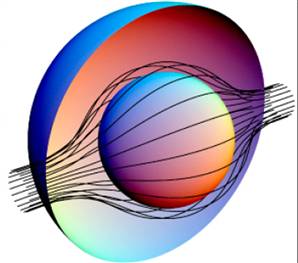
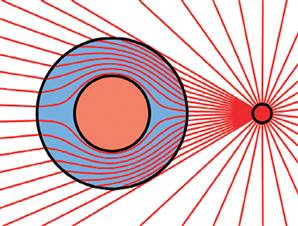
But now there is a new method four. Scientists at Duke University, the Imperial College London, and the SensorMetrix company in San Diego have created a device that reduces an object’s reflectivity and shadow. It diverts the light rays around the object so they do not reflect off it. If it reflects no light, you can’t see it. (Associated Press, 10/19/06) (Diagrams from MSNBC)

(Actually, the device only works in 2 dimensions, not three, and it diverts microwaves, not visible light waves, but it is a demonstration of the feasibility of the concept).

How is this device different from putting a box over the object, which also prevents it from reflecting light? It differs in that you would not see the object or the box. You would just see the background behind the object as if it were not there.

In principle, you could touch the object and feel that it was there, but you couldn’t see it because no light would be reflected from it.


Microwaves bent by the concentric walls of this 1-centimeter-thick invisibility device circumvent the center area and emerge on their original paths as if nothing had been in the way. The copper hoop that was cloaked in the tests isn't pictured. Picture from Science News, Oct. 21, 2006; Vol. 170, No. 17 , p. 261.


Now what if I were the hidden object at the center of the device? I could be standing right in front of you and you wouldn’t be able to see me. But I couldn’t see you either! Any light reflected from you toward me would be diverted around me by the cloaking device and would never reach me. So I would see nothing.

I would be functionally blind. I could hold my hand in front of my face but I couldn’t see it because I need incident light to see things and there wouldn’t be any. For me, it would be like being in a totally pitch-black room. So invisibility makes you blind.

But what if I had a small flashlight with me? I could shine that on my hand, which would reflect the light and I could see my hand. I could read a book if I wanted. It would be like turning on the lights in my room.

If I shined my flashlight outward toward you, you would not see me, but only a strange bright spot in the background behind me.

If I shined the light onto myself, you would be able to see me, at least the parts of me illuminated by my flashlight. But I would seem to be a ghost, not properly connected to the background, because I would be illuminated by a different light source than the ambient incident light that was being diverted around me. Maybe it would look like stage lighting. And my eyes would appear as two black holes, because where they absorbed the light shining on me, none would be reflected back to you.

But I still couldn’t see you. I could only see the parts of my body illuminated by the light. No other reflected light would reach me. I would still be blind to the world.

So as far as the Harry Potter invisibility cloak goes, it wouldn’t be practical because its wearer would be functionally blind, although if his head stuck up out of the cloak, he could see while his body remained invisible, to himself and to others. That probably wouldn’t be very practical either. If you couldn’t see your own body, you probably would have trouble walking or moving about for any length of time. It would be like walking while looking up at the sky. You would soon bump into something or fall down, I think.

Sunday, October 15, 2006

How Do Maps Work?

I was lost in a shopping mall so I found a directory map and there was a big red circle on it labeled, "You Are Here." But what did that mean? I was not even touching the map. Now, if the big dot were on the floor and I was standing on it, it would make sense for the dot to say, You Are Here. But that wouldn't be helpful.

From what point of view was I “here” at the red dot on the map? Somebody who had an impossible view of a transparent mall from a blimp overhead, might be able to identify my spatial location in relation to the shops and corridors around me, and they could take a picture and put a dot on the image and say, "He is here." But that wouldn’t help me.

A map is a view from nowhere. How does one take a view from nowhere when each of us is always somewhere?

A map that includes a representation of its viewer is a paradox, and yet you must have an idea of where you are on a map in order to read it. But you can't be represented on the map and the viewer of the map at the same time.

I don't understand how maps work.

Sunday, October 08, 2006

What Could This Mean?

Here is an actual sentence from an article I did not finish reading:

"In this context of political defeat and disillusion with the possibilities of subjective action, structuralism, with its discovery of a Platonic world of mental phenomena conceived on the model of Saussurrean langue, immune from material determination, historical forces, or the effects of social activity, and equally insulated from the illusions of subjectivity, transmuted the political alienation of a generation into the appearance of an apolitical, scientific approach capable of penetrating levels of humane psychological and cultural reality inaccessible to either traditional Marxism or Sartrian phenomenology."

--
Terence Turner, Bodies and Anti-Bodies, in Csordas, T.J. (Ed.) Embodiment and Experience: The existential ground of culture and self. Cambridge: Cambridge University Press, 1994, pp. 32-33.

Monday, October 02, 2006

Why is it so much easier to destroy than to create?

You drop a serving tray full of dinner on the floor and it is ruined. The whole thing takes maybe 2 seconds. Yet it might have taken hours to prepare the meal and who knows how long it takes to make a dish.

You can destroy a person's reputation in a few days, but it takes years to build a reputation.

Your house, that took months to build and perhaps years to furnish with your stuff, can burn to ashes in an hour.

You can kill a person with one bullet in one second, even though it took that person their whole life to become that person.

The asymmetry in effort between creation and destruction doesn't seem reasonable. Why is it that way?