Behavior genetics is the modern astrology. Both strive to assert extrinsic cause, meaning and purpose to human psychology. Both are wrong.
Behavior genetics is the modern astrology. Both strive to assert extrinsic cause, meaning and purpose to human psychology. Both are wrong.
 Richard Feynman, Nobel laureate in physics, said that if our eyes were ten times more sensitive than they are, we would detect extremely dim light of one color as a series of intermittent flashes of equal intensity. That's remarkable! It follows from the fact that light is a particle, or at least a series of packages, not a "beam."
 But I wonder if we would see the world with more sensitive eyes any differently. We would integrate the electromagnetic packages much as our minds make motion pictures out of a series of stills presented at 24 frames a second. The kind of animals we are, with the kind of bodies we have, and the kind of mind we have, requires that the physical world be made of solid objects, and that light from them be steady. So we would overlook discrepancies (as we do now with the blind spot, perspective effects, and constancies of color and size, for example).
Still, if we are so committed to seeing the world in a certain way, regardless of the stimulation of our sense receptors, then it makes you wonder if we really know anything about what's "out there."
Reference: Feynman, R. P. (1988). QED: The strange theory of light and matter. Princeton University Press.

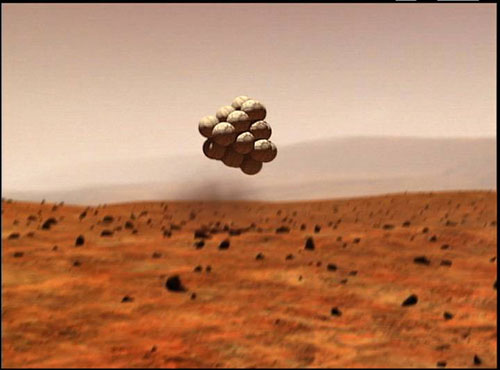 anyhow with front and side airbags. Why not go all the way with the concept? Airbags inflated everywhere except the bottom and the front window. Forget the sheet metal entirely. It would be a very light vehicle and get high fuel economy. If you hit anything, or got hit, you would just bounce. It worked for the Mars explorer. It could work on the highway.
 Scientists have announced that the universe grew from “the size of a marble” to “astronomical proportions” in a trillionth of a second after the big bang, 14 billion years ago. It is a deduction from examination of the cosmic radiation background, which is supposedly the afterglow of the big bang.
  tant?
tant?
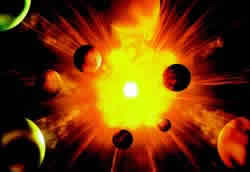 The big bang is a mathematical singularity, an artifact of the equations that physicists use. It’s like starting with a hundred jellybeans and each day eating one. As soon as you understand that process, you realize that a hundred days from now, you will have zero jellybeans. It’s a mathematical result, an artifact of the human mind. It does not mean that today’s jellybeans do not exist because in a hundred days they will be gone.
 Consider this analogy. You wind your watch (or put a battery in it), then it "keeps time." On it's own! Isn't that amazing? That's the entire rational basis for belief in AI. It is incredible that this simple- minded analogy supports an entire academic discipline. Many scientists seriously believe that if you store some instructions for action in a machine, then step back and watch those instructions execute later, that you are witnessing artificial intelligence.
 For years I believed it might be possible to create genuine intelligence in a computer. I learned to program computers and worked on the problem for twenty years. Finally I realized that the problem is badly formulated. We need to define "intelligence" before we can hope to synthesize it. I have a definition of intelligence now, and unfortunately, it makes it impossible to synthesize intelligence. The essence of intelligence is a self-relating existence. It is to exist in a way that takes its own existence into account. A stone does not do that. Any animal does.
 What if orgasms were not pleasurable? The physiology would work exactly as it does now, so there would be no biological barrier to reproduction. But it just wouldn't be pleasurable. Would that make any difference?
 It shouldn't, if you take a biological view of human nature. Pleasure (and pain) are mental, psychological experiences. As such, they are not necessary to human life or human evolution. The body and its genes do whatever they need to do, regardless of what the animal thinks about anything.
Taking a psychological point of view though, if orgasms gave no pleasure, that might have unexpected effects on human life. Sex would be about just getting those eggs fertilized, just another bodily chore, like brushing your teeth. I wonder if the population growth of our species would have followed the same trend. There would be no contraception-- no need for it. Would there be marriage?
Masturbation would never occur, of course, since there would be no reason for it. Would there be pornography? The mystery of bodies would still be interesting, so it might. It might affect men and women differently. But without the pleasure of orgasm, I don't think the society would put any social taboo on bodies, so nudity would be ordinary, routine, not forbidden. There is something about pleasure that makes people worry, not nudity itself. I don't think sex is what they want to regulate, but pleasure.
Would romantic love actually be more interesting if orgasms gave no pleasure? Without the motivation of orgasm, people might find each other more interesting, in more subtle ways.
Somebody should do a sci-fi story on this idea.

1. Pictures show stasis, when reality is process.
2. Pictures show the outside when reality is the inside.
We tend to believe that the camera doesn't lie. But it does. Not with trick photography, but simply because it objectifies human experience. We don't think much about it now, since images of people are omnipresent. But prior to the 19th century, when there were no cameras, people might have thought differently about themselves, others, and life.
Modern, chronic self-objectification is why we cannot understand the cave paintings in Europe. And why we are mystified that there are no human representations on them. Something has happened to the human psyche since then. We used to experience life but now we would rather look at it, and even look at ourselves looking at it. There is nothing left on the inside.

Here is a picture of the Martian Horizon, taken from its surface. It gives me an eerie feeling. Why?
The eerie feeling is a holdover from traditional thinking that the heavens are home to the gods. We know better, but for millennia the heavens have “looked down” upon us. Now we look out from the heavens across a Martian horizon. It's a radical shift in world view.
ARE WE ALONE?
The Mars mission is motivated in part by the search to find extraterrestrial life, or at least water, which would increase the probability that there is, or was, life on Mars. Some interviewer on NPR, asked a scientist, “Why does that matter?”
The scientist answered, “One of the greatest questions we can ask is, Are we alone?”
Finding life on Mars would instantly create a “them.” The discovery would not lead to a great insight, but rather, to a familiar pattern of human psychology: Us and Them. "We" would not be alone, because "they" were there. It would group all humanity in the most superficial sense, as "us." We would probably kill "them," because that has always been our history, our way, as a species.
A SNAPSHOT OF GOD?I think what makes the question, “Are we alone” seem more important than it is, is a tacit logic: We believe God created life here on Earth, and presumably, life on Mars did not get there from here, so if there is life on Mars, we could conclude that God created it there too.
Therefore what?
It would mean that we living things here on Earth are not “special.” Would that be big news? It sounds like a child coming to realize that its parents have other interests. It's a childish idea.
I think what really captures people’s imagination in the question is a muddled theological argument. Millions of people watching the pictures come back from Mars will be looking not for information about Mars, but for a candid snapshot of God. Scientists themselves, it seems, are not immune from that vestigial wish.
 Posts
All Comments
Posts
All Comments