Sunday, October 15, 2006

How Do Maps Work?

I was lost in a shopping mall so I found a directory map and there was a big red circle on it labeled, "You Are Here." But what did that mean? I was not even touching the map. Now, if the big dot were on the floor and I was standing on it, it would make sense for the dot to say, You Are Here. But that wouldn't be helpful.

From what point of view was I “here” at the red dot on the map? Somebody who had an impossible view of a transparent mall from a blimp overhead, might be able to identify my spatial location in relation to the shops and corridors around me, and they could take a picture and put a dot on the image and say, "He is here." But that wouldn’t help me.

A map is a view from nowhere. How does one take a view from nowhere when each of us is always somewhere?

A map that includes a representation of its viewer is a paradox, and yet you must have an idea of where you are on a map in order to read it. But you can't be represented on the map and the viewer of the map at the same time.

I don't understand how maps work.

Sunday, October 08, 2006

What Could This Mean?

Here is an actual sentence from an article I did not finish reading:

"In this context of political defeat and disillusion with the possibilities of subjective action, structuralism, with its discovery of a Platonic world of mental phenomena conceived on the model of Saussurrean langue, immune from material determination, historical forces, or the effects of social activity, and equally insulated from the illusions of subjectivity, transmuted the political alienation of a generation into the appearance of an apolitical, scientific approach capable of penetrating levels of humane psychological and cultural reality inaccessible to either traditional Marxism or Sartrian phenomenology."

--
Terence Turner, Bodies and Anti-Bodies, in Csordas, T.J. (Ed.) Embodiment and Experience: The existential ground of culture and self. Cambridge: Cambridge University Press, 1994, pp. 32-33.

Monday, October 02, 2006

Why is it so much easier to destroy than to create?

You drop a serving tray full of dinner on the floor and it is ruined. The whole thing takes maybe 2 seconds. Yet it might have taken hours to prepare the meal and who knows how long it takes to make a dish.

You can destroy a person's reputation in a few days, but it takes years to build a reputation.

Your house, that took months to build and perhaps years to furnish with your stuff, can burn to ashes in an hour.

You can kill a person with one bullet in one second, even though it took that person their whole life to become that person.

The asymmetry in effort between creation and destruction doesn't seem reasonable. Why is it that way?

Monday, September 25, 2006

Could I See With My Tongue?

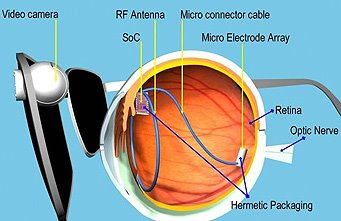
I saw a show on TV about an artificial retina. A tiny computer chip contained

photocells whose electrical signals stimulated the optic nerve. The blind guy could "see" light patches projected on a wall, could locate them in space, and could discriminate vertical and horizontal orientation.

What was he seeing? Electrical signals? His own brain? Surely not light, because he was blind. But he said patches of light.

What if, in the middle of the experiment, all the lights in the room were cut, leaving a totally dark room, but the computer continued to trigger the same patterns of electrical signals to the optic nerve as before. The guy should continue to see rectangles of white light, just as described before. But there would be no light in the pitch-black room. So would he be wrong in saying that he saw patches of light?

What does it mean to "see" something if no actual light is involved? If seeing only means that a certain area of the brain is active, then if I routed electrical signals from my tongue to the visual area of my brain, I should be able to see light when I suck a lemon. It's logical, but I'm not sure if I believe it.

Saturday, September 16, 2006

Do Funnels Take Up More Space Than They Should?

A funnel is difficult to store, whether you put it in a drawer or hang it on a wall. It seems to take up way more space than it should. Nothing else stacks or packs well with it, not even other funnels of the same size. A funnel is an odd shape, and it is difficult to estimate visually how much space it needs. Why is that? It seems somehow related to its function.

Sunday, September 10, 2006

What is Food?

Here is the actual list of ingredients on a "snack" offered to me on an airline. It was a “potato skins snack chips” from Poore Brothers, Inc., of Goodyear, AZ. It contains:

Corn oil, partially hydrogenated cottonseed oil with TBHQ, dehydrated potatoes, potato starch, corn, sugar, salt, cheese powder, whey, partially hydrogenated soybean oil, maltodextrin, disodium phosphate, nonfat milk, citric acid, artificial flavor, lactic acid, potassium chloride, monosodium glutamate, buttermilk solids, mono and diglycerides, dextrose, butter solids, caramel color, beta carotene, FD&C yellow #5, red #40, blue#1, extractives of turmeric and annatto, hydrolyzed soy protein, dehydrated onion, yeast extract, molasses powder, dried sour cream, disodium inosinate, disodium guanylate, malic acid.

By category:

Vegetables & Legumes:

Corn

dehydrated potatoes

potato starch

hydrolyzed soy protein

dehydrated onion


Dairy:

cheese powder

whey

nonfat milk

butter solids

dried sour cream

lactic acid


Oil:

Corn oil

hydrogenated cottonseed oil with TBHQ

partially hydrogenated soybean oil

Sugar:

sugar

dextrose

maltodextrin

molasses powder

Salt:

salt

potassium chloride

Color:

disodium phosphate

caramel color

beta carotene

FD&C yellow #5, red #40, blue#1

extractives of turmeric and annatto

Flavor:

citric acid

artificial flavor

monosodium glutamate

yeast extract

Texture or preservative:

mono and diglycerides

disodium inosinate

disodium guanylate

malic acid

This snack is a marvel of modern food engineering, no doubt. It has things in it that are derived from familiar foodstuffs. And much else besides. You have to wonder, does the end result really qualify as food at all?

Needless to say, I did not eat my "snack." I did not consider it to be food.

Saturday, August 26, 2006

Why Do Military Planes Fly in Formation?


Wouldn’t flying in formation make them a larger, easier target for a SAM than if they were widely dispersed? The Blue Angels I can understand – that’s a stunt. But over military airports you often see planes in tight formation, and of course, always in war movies.

I asked a pilot friend who flew in Vietnam and he couldn’t give a good answer. He described how you do precision flying, how difficult it is, etc. But not why. When pressed, he said, vaguely, that it was good for training. That's not an answer. I don't get it.

Saturday, August 12, 2006

Why Are We Born Ignorant?


Why are we born ignorant, rather than wise?

We spend our whole lives trying to figure out what’s going on and just when we start to get a clue, we die. Isn’t that backward?

Sunday, July 30, 2006

How Do Spider Webs Get Started?

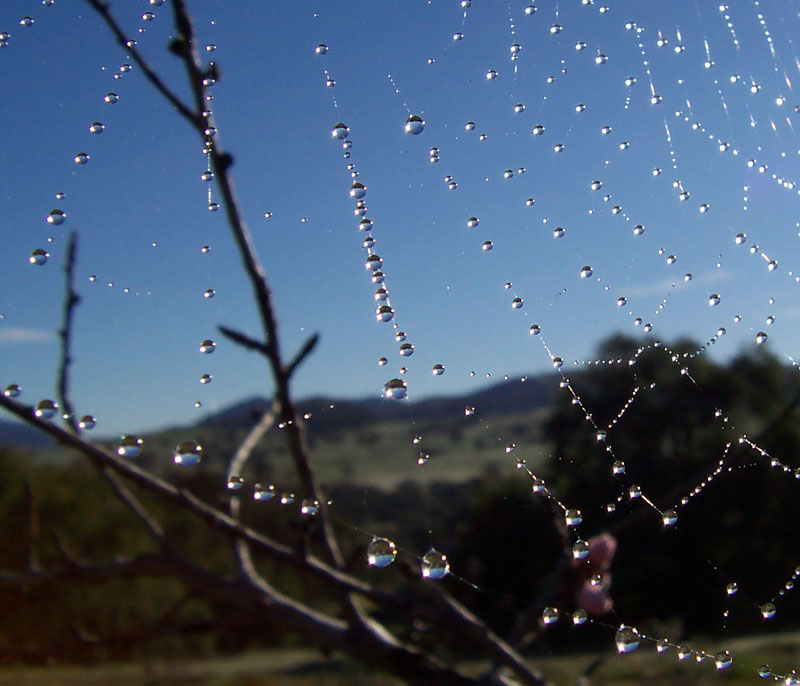
When I walk through the woods in the morning, the trail is filled with spider webs, many, disturbingly, at face height. In some places the trail is four feet wide between closest branches on either side. So my question is, how did the spider get the first line across the trail, in order to build the web? I don't believe a spider can jump four feet through the air. Do they attach a line to a branch then walk into the tree trunk, down the tree, across the ground, up the other tree trunk, to the same height as they were? All the while they would be spooling out silk and not getting it tangled on anything? I don't think that's feasible. The weight of the silk line would be too much to haul up the second tree anyway. Maybe the spider throws or shoots the first line across the trail. But I don't think spiders can do that. Another possibility is that the spider fastens a line high up on one branch and then swings like Tarzan across the trail to a branch on the other side. That seems improbable, but it could be right. I wonder if they beat their little spider chest with eight tiny fists as they swing from the silk line, and even let out a spider-sized "aah-eee-aaah!" as they make the trip.

Monday, July 24, 2006

Inconvenient Consequences of Global Warming


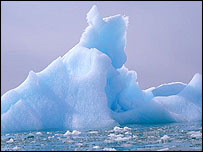
We’re all aware of what can happen if global warming continues: melting ice caps, rising sea levels, flooded (or submerged) cities around the world (including my own!).

Some of the less obvious changes will be (and are already), different mix of species, with extinction of some, migration of others. As ecologists know, the relationships are complex. If a predator can’t make it because it gets too warm, its prey species will balloon out of control. And it will probably be insects!

Likewise, if a food source like plankton diminishes because the water is too warm or too cold, the ripples go all the way up the food chain to us.

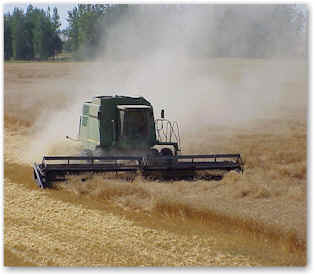
Agriculture will move farther north and south away from the equator. Canada’s Yukon Territory will be the breadbasket of North America, not the Kansas desert. Political and economic power will move with the agriculture.

One of the most disturbing possibilities is that the electrical grids of industrialized nations will completely fail. They are already wobbly, and with the stresses of future extremes of heat and cold, it will collapse. We don’t appreciate how much we depend on the electrical grid in every action of our lives until the power goes out for a day or two.

There will be no heat or air conditioning, of course, which makes everybody cranky. No computers or internet either, which would not merely be a throwback to 1980’s communication, because printing presses wouldn’t work until they got hooked up to expensive, petroleum-dependent generators. Scholarly and pop culture communication would rely only on expensive printed material, as it did from the seventeenth century up to about 1980. The computer industry would be kaput.

TV and radio would cease to function. On the upside, we wouldn’t have to listen to the lies of politicians and advertisers. Of course the media could get generators, but there would be few customers able to receive their product. So that would be the end of that industry, too. It might be a relief. Traveling snake oil salesmen are much easier to avoid than ubiquitous ads.

However, without mass media, the public stories we tell each other to maintain social cohesion would be lost and the country would devolve into isolated villages or regions. Maybe that wouldn’t be a bad thing, socially, but the loss of economic transparency would raise all prices painfully. Inevitably, isolated regions would develop unique cultures and predictable xenophobia. Secessions and wars would follow after only a few generations.

We will go to the market every day because there will be no refrigeration for food beyond ice. That will change the way food is produced, stored, and sold. It will change our diets. We will spend more time raising and preparing food and less time reading, writing, and racing dirt bikes. And when we’re not preparing food, we’ll be heating water and washing clothes by hand. But it would be a good time to get into the ice business.

There will be an unsustainable run on wax candles and batteries. But on the plus side, most of us will finally find relief from chronic sleep deprivation. And instead of CDs and movies, we will seek out live musicians and theatrical troupes.

Would the electrical grid be repaired? Of course. Despite the nostalgic charms of a non-electrified world, most of us enjoy the modern world too much to go back to that. People will pay any price to restore the grid. But hopefully, in doing that, we will think twice about how we generate and use electricity, perhaps making some wiser decisions the next time around.

Image: www.lymeline.com/artest.htm



Saturday, July 08, 2006

Friday, June 30, 2006

Where Do Colors Come From?


In the world there is electromagnetic energy that varies in frequency and intensity but it is not “colored” frequency and intensity. Electromagnetic energy is colorless. When humans absorb vibrations in the range of 350 to 750 nanometers, we experience colors from blue to green to red. But that’s about us, not the world. There is no color in the world. There is no color in the brain. So where does the color come from?

Monday, June 26, 2006

What is Life?

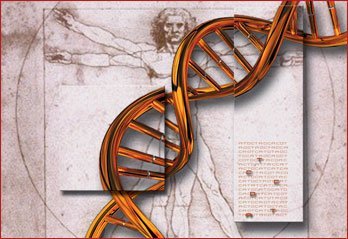
Usually life is defined as a certain a set of activities or processes, such as reproduction, metabolism, irritability. But it is not too difficult to come up with examples that meet each criterion and yet which are not alive, according to common sense. Crystals grow, for example. Fire “metabolizes” fuel, grows, and reproduces itself. Rivers are irritable, in that they try to get around rocks, dams, and other obstacles placed in their path.

Just having DNA is not good enough, since I don’t want to say that a test tube full of DNA is alive. Is a virus alive? Scientists aren’t sure. If it is alive, does it stay alive when you take it apart, or is there something special about the system of parts that confers aliveness. Are gametes alive (e.g., sperm and egg cells)? Spermatazoa certainly look alive, but they do not have full complement of DNA, and can’t reproduce.

At some point, one is forced into a corner, defining life simply as those things that are alive, and the definition is totally circular. That's no good.

I don’t think there is a special “life force,” but I think the question of life must be wrongly formulated somehow.

Image from:
http://stwww.weizmann.ac.il/g-chem/chemlife/imgs%5Cfrontpage.jpg

Monday, June 19, 2006

How Tall Can A Tree Get?

There are some very tall, old-growth fir trees near my house. Some of these trees are at least 4 feet (1.5 m) in diameter at their base and must be at least a hundred and fifty years old. Some of them tower 100 to 150 feet high (30-45 m), I would guess. How tall could they get, assuming they did not eventually succumb to disease or lightning? Is there any practical limit? One limiting factor is the difficulty of getting water up to the top to supply growth. Water is heavy. What does it take to lift water 150 feet or more in the air?

Water gets up the tree partly by capillary action, but also because it is sucked up by a sort of hydraulic vacuum. The needles transpire, giving off water, creating a negative pressure in the capillaries, which are completely closed pipes all the way down to the roots. The negative pressure at the needles literally sucks water out of the ground, right up to the top. That may not be exactly right, but that’s what I believe.

Still, even given that the water transport system is a water-tight vacuum pump, there must be some limit to how much vacuum fir needles can create at the top before they implode from negative pressure. Also, why wouldn’t all the lower down needles sap off the water and reduce the pressure long before the water ever got to the top?

There’s also a structural problem. Wood can only withstand so much compression before it splinters and splits. At some point the weight of the tree would simply crush the wood near the ground and the tree would collapse from its own weight. Why haven’t I ever heard of that happening?

So I just don’t know how tall a tree can get.

Saturday, June 10, 2006

What is the Purpose of the Retinal Image?


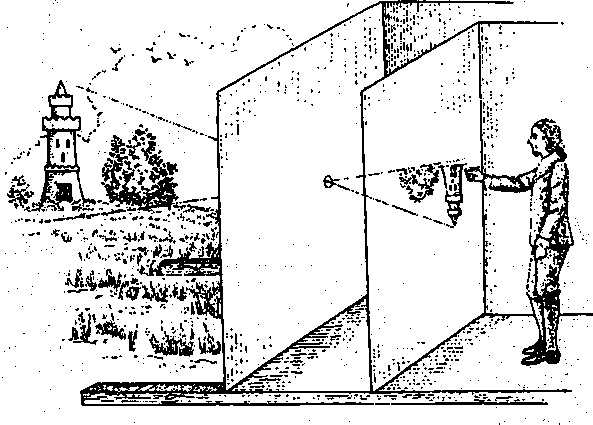
In some ways, the eye works like a camera obscura, as Kepler described in 1604. The lens of the eye forms an upside-down and backward, two-dimensional image of whatever you are looking at, on the concave inner back wall of the eye. A doctor can see your retinal image when she looks into your eye. But you can’t see your own retinal image, so what is the point of having it? And even if the retinal images were copied to the brain (which they are not), you still couldn’t see them. What are they for?

Friday, June 02, 2006

Where Do We Go at Night?

Once a day, I lie still in a specially darkened and quieted room, and wait to be taken away. I have covered myself in blankets to assist in thermoregulation in the hours ahead, just as an astronaut dons a space suit prior to an extra-vehicular adventure. And in twenty minutes, I am gone. Where, I do not know. Seven or eight hours later, I have returned, with only a few uninterpretable dream snapshots of where I have been. This happens every single day of my life. Why do I accept that as perfectly ordinary? It’s incredible! One third of my life is spent in some other world I know nothing about!

Monday, May 22, 2006

Are Armpits a Design Error?


Armpits sweat uncomfortably and often stink, unless you take measures to prevent that. Dogs have no armpits. But if you turn a four legged animal upright, and let the front legs hang down from the shoulders, you get armpits. A better design for human arms would be to have them stick straight out from the trunk, with an omnidirectional elbow, or at least have them hang down from cantilevered clavicles, away from the trunk. Even an octopus does not have armpits. The transition from four-legged to upright locomotion was not well-planned, with respect to armpits.

Friday, May 12, 2006

Mirrors


Why does a mirror reverse the image side to side but not top to bottom? If you hold a page of text up to a mirror, it is hard to read because the image is backward. But the top is still the top, and the bottom is still the bottom. Why is that?

Monday, May 08, 2006

The Size of the World

I was watching some documentary show about planetary exploration and I saw an image showing one of the Mars probes orbiting the planet. It looks like an aircraft coming in for a routine landing.

Mars is becoming familiar to us now. I imagine that in the future, after I'm gone, it will be very familiar. "Oh yes, we went to Mars Base Three on our vacation. You should go. Great food, interesting music."

And that, in turn, made me think about how small the world was for the ancient Greeks. For them, the whole world was the Mediterranean Sea. They had no idea what else was out there. The idea of north and south American continents was inconceivable. Their world was tiny but it was the big bad world as far as they were concerned. We look back on that and wonder, what would it be like to believe that the world was that small? It seems sort of comforting.

Now, our world is global. It is trivial to vacation in Rio, Bali, or Sydney. New Yorkers pop over to London for a meeting. People in Seattle go to Tokyo to see a friend. We visit family in Hong Kong, Cape Town, and Edinburgh. We don't yet think about casually going to Mars, but we will.

In the future, people will look back on our time and think, I wonder what it was like to live in such simple times, where you thought of your world as just one planet? That would have been so comforting.

Why Are there So Many Languages?

An acquaintance of mine speaks Xhosa, one of the click languages of South Africa. It is strange-sounding indeed. There are so many languages and they all seem so arbitrary. Imagine if people differed from each other in configuration of eyes and limbs, to the extent that Xhosa differs from English. It doesn’t seem reasonable that there should be so many mutually unintelligible languages when human beings are so much the same in so many other ways. Why can't we all understand each other?

Sunday, April 23, 2006

Astrology Today


Behavior genetics is the modern astrology. Both strive to assert extrinsic cause, meaning and purpose to human psychology. Both are wrong.

Monday, April 10, 2006

What Do We See?

Richard Feynman, Nobel laureate in physics, said that if our eyes were ten times more sensitive than they are, we would detect extremely dim light of one color as a series of intermittent flashes of equal intensity. That's remarkable! It follows from the fact that light is a particle, or at least a series of packages, not a "beam."

But I wonder if we would see the world with more sensitive eyes any differently. We would integrate the electromagnetic packages much as our minds make motion pictures out of a series of stills presented at 24 frames a second. The kind of animals we are, with the kind of bodies we have, and the kind of mind we have, requires that the physical world be made of solid objects, and that light from them be steady. So we would overlook discrepancies (as we do now with the blind spot, perspective effects, and constancies of color and size, for example).

Still, if we are so committed to seeing the world in a certain way, regardless of the stimulation of our sense receptors, then it makes you wonder if we really know anything about what's "out there."

Reference: Feynman, R. P. (1988). QED: The strange theory of light and matter. Princeton University Press.

Friday, March 31, 2006

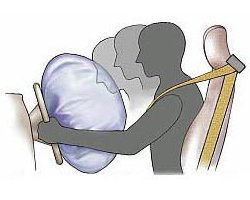
The Airbag Car


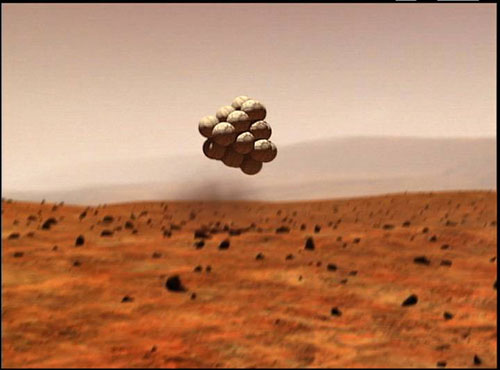
Why are cars still made of steel when airbags have been shown to be so effective? Why not make a car that is all airbag? The occupants would be surrounded by airbags instead of metal on all sides. We're moving that way anyhow with front and side airbags. Why not go all the way with the concept? Airbags inflated everywhere except the bottom and the front window. Forget the sheet metal entirely. It would be a very light vehicle and get high fuel economy. If you hit anything, or got hit, you would just bounce. It worked for the Mars explorer. It could work on the highway.

Thursday, March 30, 2006

How Big Is A Marble?

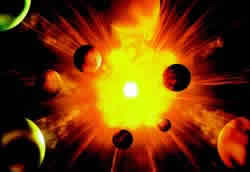
Scientists have announced that the universe grew from “the size of a marble” to “astronomical proportions” in a trillionth of a second after the big bang, 14 billion years ago. It is a deduction from examination of the cosmic radiation background, which is supposedly the afterglow of the big bang.

I can’t tell if the scientists who make such statements are just trying to “dumb down” the physics for popular consumption, or if they really are that dumb. Announcements like that are paradoxical and incomprehensible.

If the entire universe, everything that exists, was “the size of a marble,” what does that mean? A marble compared to what? Who would be looking at it?

Are we invited to imagine that we were floating outside the universe, (which is impossible, since the universe is everything), looking down on this cute little marble sized universe (again impossible), and we watch it explode to incomprehensible size in an incomprehensible instant?

Only God could exist outside the universe like that. So the scientists are saying, in effect, “Imagine you are God, beyond all that exists.” And I’m supposed to say, “Okay, no problem.” Because it is utter nonsense to imagine that a human being could have a point of view, even in imagination, beyond all that exists. How would we know what it's like to be God?

Also, after the explosion we have to change our mental image and get back inside the universe somehow, in order to avoid being stranded outside the expanded universe, a lonesome transcendent God instead of an existent human being.

Scientists who think they are describing reality with their equations have become blind to their own humanity, so they don’t see the irony in their Godlike pronouncements.

The big bang is a mathematical singularity, an artifact of the equations that physicists use. It’s like starting with a hundred jellybeans and each day eating one. As soon as you understand that process, you realize that a hundred days from now, you will have zero jellybeans. It’s a mathematical result, an artifact of the human mind. It does not mean that today’s jellybeans do not exist because in a hundred days they will be gone.

In the same way, running an equation backward in time instead of into the future, it is an error in reasoning to say that today’s universe was once the size of a marble.

Sunday, March 26, 2006

The Myth of Artificial Intelligence

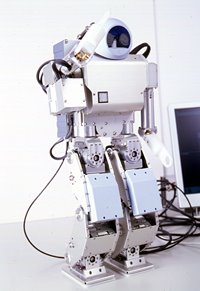
Consider this analogy. You wind your watch (or put a battery in it), then it "keeps time." On it's own! Isn't that amazing? That's the entire rational basis for belief in AI. It is incredible that this simple- minded analogy supports an entire academic discipline. Many scientists seriously believe that if you store some instructions for action in a machine, then step back and watch those instructions execute later, that you are witnessing artificial intelligence.

For years I believed it might be possible to create genuine intelligence in a computer. I learned to program computers and worked on the problem for twenty years. Finally I realized that the problem is badly formulated. We need to define "intelligence" before we can hope to synthesize it. I have a definition of intelligence now, and unfortunately, it makes it impossible to synthesize intelligence. The essence of intelligence is a self-relating existence. It is to exist in a way that takes its own existence into account. A stone does not do that. Any animal does.